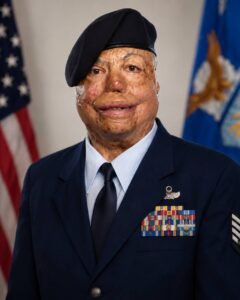
In December 2005, U.S. Air Force Tactical Air Control Party (TACP) specialist Israel Del Toro was serving in Afghanistan when his life changed forever.
While operating in the mountains, Del Toro was caught in a devastating roadside bomb explosion. The blast engulfed him in flames and left him fighting for his life.
But even in those terrifying moments, his training took over.
After being severely burned, Del Toro threw himself into a nearby creek in an attempt to extinguish the flames. Somehow, despite his injuries, he continued doing his job. He relayed critical airstrike coordinates to his unit before eventually collapsing.
What happened next would become one of the most remarkable survival stories in the U.S. military.
A Devastating Injury
The explosion had caused catastrophic injuries.
Del Toro suffered burns across approximately 80 percent of his body. He also lost fingers and sustained injuries so severe that doctors placed his chances of survival at only about 15 percent.
He was eventually placed into a coma that lasted roughly three months.
For his family, the prognosis was devastating.
But Del Toro wasn’t ready to give up.
One thought became especially important to him: his young son.
He wanted to live. He wanted to be there for his child. And he refused to allow a medical prediction to determine the rest of his life.
His recovery would become an extraordinary test of physical and mental endurance.
More Than 100 Surgeries
Surviving the initial explosion was only the beginning.
Del Toro faced years of painful medical treatment and rehabilitation. He underwent more than 100 surgeries as doctors worked to treat his extensive burns and injuries.
Recovery wasn’t something that happened overnight.
It required repeated procedures, physical therapy, rehabilitation, and enormous mental strength.
Every small improvement came at a price.
Yet Del Toro continued moving forward.
Instead of allowing his injuries to end his military career, he made an extraordinary decision: he wanted to remain in the Air Force.
For many severely wounded service members, returning to military duty can seem impossible. Del Toro, however, was determined to prove that his injuries did not erase his ability to serve.
Refusing to Let Disability Define Him
After his injuries, Del Toro faced the possibility of being medically discharged.
But he fought against that outcome.
His determination eventually led to a historic achievement.
In 2010, Israel Del Toro became the first fully combat-disabled airman to re-enlist in the U.S. Air Force.
The moment represented far more than a military milestone.
It demonstrated how determined he was to continue contributing despite injuries that had nearly taken his life.
Del Toro’s story challenged assumptions about what a severely wounded service member could accomplish after catastrophic injuries.
He didn’t simply want to survive.
He wanted to serve.
From Survivor to Mentor
After returning to military service, Del Toro took on another important role.
He began mentoring incoming tactical airmen, using his own experience to help prepare the next generation of service members.
His story gave those young airmen something that couldn’t be taught in a classroom: a firsthand example of resilience.
He understood what it meant to face fear, pain, uncertainty, and setbacks.
And he understood that physical limitations didn’t necessarily mean the end of a person’s ability to contribute.
His influence eventually extended beyond the Air Force.
Competing at the Invictus Games
Del Toro also became involved in adaptive sports for wounded, injured, and ill service members.
He competed at the Invictus Games, an international sporting event created to give wounded service personnel and veterans an opportunity to compete and demonstrate their strength and determination.
There, he achieved another remarkable milestone by winning a gold medal.
For someone who had once been given only a small chance of surviving his injuries, standing on a podium as a gold medalist represented an extraordinary transformation.
His recovery had become much more than a medical journey.
It had become a message.
Still Pushing Himself
Del Toro continued challenging himself physically and mentally.
Among his accomplishments was completing his 131st parachute jump.
For someone who had survived catastrophic burns over most of his body, returning to an activity as demanding and intimidating as parachuting demonstrated just how far he had come.
His achievements weren’t about pretending that his injuries had never happened.
They were about refusing to let those injuries dictate everything he could or couldn’t do.
Every accomplishment became another reminder that survival can be the beginning of a new chapter rather than the end of a story.
Recognition for His Service
Del Toro’s resilience and dedication eventually earned him one of the military community’s most respected honors.
He received the prestigious Pat Tillman Award for Service.
The award recognizes individuals who demonstrate exceptional character, service, and commitment to making a difference.
For Del Toro, the recognition reflected a journey that began with a devastating explosion in Afghanistan and continued through years of surgeries, rehabilitation, military service, mentoring, and competition.
His story had grown far beyond his own recovery.
He had become an example for other wounded service members and for people facing seemingly impossible obstacles.
Retiring on His Own Terms
After more than two decades of military service, Del Toro eventually concluded his decorated career.
In 2019, he retired from the U.S. Air Force after 22 years of service.
But the significance of his retirement was not simply the number of years he had served.
It was the fact that he had reached that moment on his own terms.
Fourteen years earlier, he had been fighting for his life in a hospital after suffering catastrophic injuries.
Doctors had given him only about a 15 percent chance of survival.
He survived.
He endured more than 100 surgeries.
He returned to military service.
He became a mentor.
He won a gold medal.
He completed more than 100 parachute jumps.
And he received national recognition for his service.
A Legacy of Resilience
Israel Del Toro’s story is ultimately about much more than a roadside bomb or a military career.
It’s about what happens when someone refuses to accept that their worst moment has to become the definition of their life.
The explosion changed his body forever.
But it didn’t destroy his determination.
The burns, surgeries, rehabilitation, and physical challenges became part of his story—but they didn’t become the entire story.
His journey also demonstrates the importance of purpose.
At a time when doctors weren’t sure whether he would survive, Del Toro had something powerful to fight for: his family, his son, his fellow service members, and the future he still wanted to build.
His decision to continue serving after catastrophic injuries sent a powerful message to others who might be facing their own impossible circumstances.
Sometimes resilience isn’t about returning to exactly who you were before.
Sometimes it’s about discovering how much you can still accomplish after everything has changed.
Israel Del Toro’s life after Afghanistan became a powerful example of that idea.
He wasn’t expected to survive.
He survived.
He wasn’t expected to return to military service.
He did.
And he wasn’t content simply to recover.
He continued serving, mentoring, competing, and challenging himself until he eventually chose to retire after a remarkable 22-year career.
His story remains a powerful reminder that a devastating chapter does not have to be the final chapter.
Sometimes survival is only the beginning.